As trade unions negotiate minimum wage hikes, low-income earners, especially shopkeepers, remain below the current legal wage as the current law are scarcely enforced. Our Staff Writer KONDWANI NYONDO reports:
Francis Malunga fears that rising demands for pay hikes could worsen job losses.
Last year, the 34-year-old, from Kameza Township in Blantyre, lost his job when a retail shop where he had worked for six years cut its staff amid rising operational costs.
Now, he survives largely on a K60 000 salary earned by his wife, a domestic worker in the city.
She pays K15 000 monthly rent for a grass-thatched house while the remainder barely covers water, food and other necessities.
The jobless father of five cannot imagine his wife losing the job due to demands for increased pay and pension contributions for domestic workers.
“What if her employers decide they cannot manage?” he asks.
In a worn file, Francis keeps a retrenchment letter, which reads: “…the company can no longer sustain its workforce… we may consider re-engagement if conditions improve.”
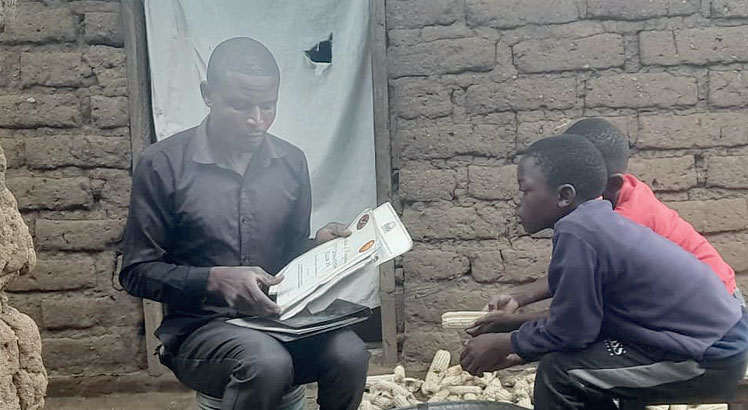
Three colleagues of his received similar letters.
A year later, none has been recalled.
Armed with a Malawi School Certificate of Education, Malunga has submitted about 40 job applications and attended two interviews.
He was among 47 083 job seekers between April 2025 and March 2026, the Malawi Government Annual Economic Report shows.
The district labour offices’ tallies show only 1 841 successfully matched employment opportunities—leaving about 45 000 in the cold.
Meanwhile, a perception survey released by Afrobarometer last December shows at least half of the youth remain unemployed despite actively searching for jobs.
In May last year, government raised minimum wages from K3 461.54 to K4 846.16 per day, totalling K126 000.16 monthly.
Domestic workers’ legal wage rose from K2 000 to K2 800 daily, increasing their monthly pay from K52000 to K72 800.
For small enterprises, the daily minimum wage increased from K2 884.62 to K4 038.47, hitting K105 000.17 monthly. The Ministry of Labour, Skills and Innovation ordered medium-sized enterprises to pay their staff at least K4 846.16 daily while businesses with an annual turnover of K500 million were supposed to pay no less than K5769.23 per day or K150 000 monthly.
Currently, the Malawi Congress of Trade Unions (MCTU) is petitioning for a 95 percent increase in the gazette minimum wage.
MCTU president Charles Kumchenga argues that rising fuel prices, VAT increases and inflation have eroded workers’ purchasing power.
“Workers are struggling,” he says. “Prices of basic goods and services continue rising while wages remain too low.”
But some shop workers are still living below the prescribed minimum wages.
At Bwalolanjovu in Lilongwe, a young man disguised as Peter has worked in a retail shop for three years, but still earns K70 000 monthly even though the minimum wage has been adjusted twice.
Similar accounts echo from shop corridors in Limbe, Blantyre, where most shop owners pay between K50 000 and K90 000 monthly, which falls below the cost of living and the revised minimum wage.
Yet workers work in silence because unemployment feels harsher, Peter and his two colleagues say.
“We deserve better pay, but we also fear losing jobs,” he says. “We hear about trade unions, but they don’t engage us directly. If they did, I would tell them to tread carefully because companies are struggling and pay hikes may cost our jobs.”
The anxiety partly explains why some underpaid workers seldom report employers who defy the minimum wage law.
Economist Christopher Mbukwa says the minimum wage should be guided by key economic indicators, including the cost of living and businesses’ capacity to absorb ballooning wage bills.
Ignoring these factors could create tricky imbalances, including job losses and business closures.
“There will always be casualties on both sides, but with the right data and consultations, an optimal rate can be reached,” says Mbukwa who teaches economics at Mzuzu University.
Kumchenga says the minimum pay lobby was consultative.
“We engage workers and other stakeholders through the tripartite system. The process is consultative and reflects the realities workers are facing,” he says.
Some shop owners interviewed in Blantyre argue that economic shocks such as rising import costs, transport expenses, weakening local currency and falling demand for goods make compliance difficult.
“Since 2021, the economy has been shrinking, yet wage adjustments keep coming. Businesses are under pressure,” said one. “This leaves employers with two difficult choices—to reduce staff or keep wages at levels the business can survive on.”
However, workers desperate to keep their jobs say pangs of unemployment are numbing.
The economic outlook shows Malawi’s ailing economy grew by about 4.6 percent in 2021, but slowed to 0.9 percent in 2022, about 1.9 percent in 2023 and 1.8 percent in 2024.
The economy remained weak last year, growing by 2.7 percent amid persistent forex shortages, high inflation and low business activity.
Ministry of Labour, Skills and Innovation spokesperson Tabbu Kitta says it is aware of workers’ dilemma and non-compliance with gazetted minimum wage.
“That is why we continue strengthening labour inspections and enforcement mechanisms,” she says. “The objective is to balance worker welfare with business sustainability.”
According to Kitta, the minimum wage review involves a structured, consultative process involving key social partners.